How to Buy Property in Spain Remotely? Good Question!
In fact, you don’t need to be there. British, German, and Scandinavian buyers are purchasing, renovating, and maintaining Spanish homes without a single flight — here’s exactly how they do it.
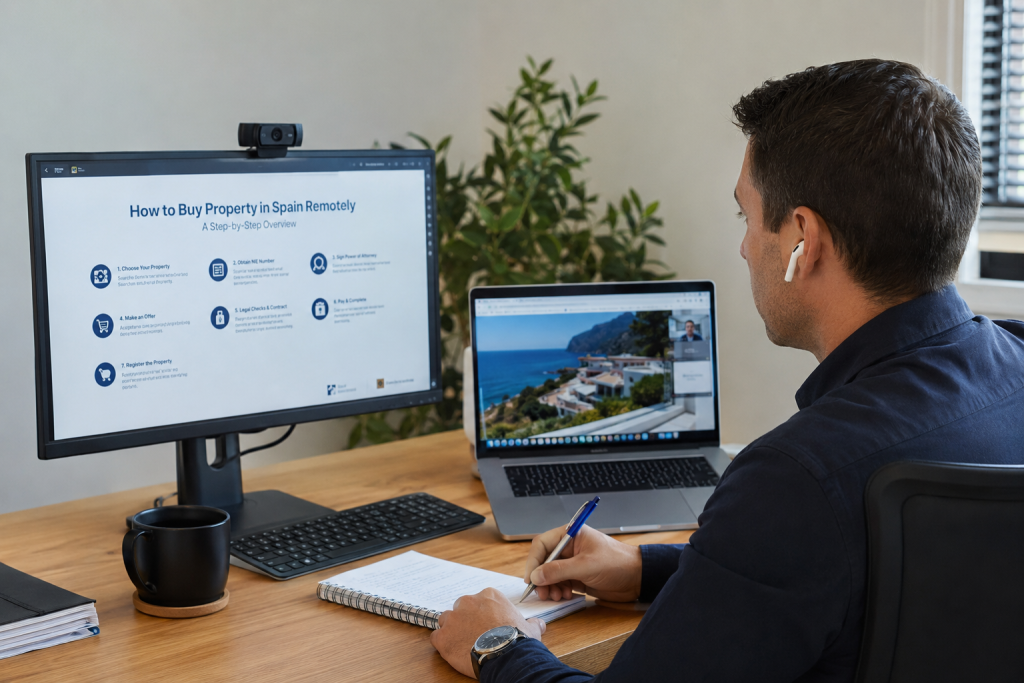
Table of Contents
- Can you really buy property in Spain without visiting?
- Why remote buyers need a boots-on-the-ground representative
- Property inspection remotely: what gets checked and how
- Renovation oversight from abroad: managing works without being there
- Home watch services: protecting your Spanish property year-round
- Upgrade coordination: increasing value before you arrive
- The legal process for remote buyers
- Step-by-step: how a remote purchase actually works
- Costs and realistic timelines
- Frequently asked questions
Can You Really Buy Property in Spain Without Visiting?
The short answer is yes — and tens of thousands of buyers from the UK, Germany, Sweden, Norway, and Denmark do it every year. Spain’s property market is one of the most internationally accessible in Europe. The legal framework explicitly accommodates non-resident buyers, and the combination of Power of Attorney (Poder Notarial), digital banking, and on-the-ground representation means that geography is no longer a meaningful obstacle.
That said, buying property in Spain remotely is not the same as buying blindly. The buyers who do it successfully are those who solve the core problem of remote purchasing: they cannot physically be present to verify what they are buying. A beautiful listing photo tells you nothing about the water pressure, the condition of the electrical installation, whether the neighbour has an illegal extension, or how the roof held up in last February’s gota fría.
This is precisely why the role of a trusted local representative — someone with professional expertise who acts solely in your interest — has become the essential component of any successful remote purchase in Spain.
“The buyers who succeed remotely are not the ones who trust the agent’s photos. They are the ones who have someone on the ground who reports to them, not to the seller.”
Why Remote Buyers Need a Boots-on-the-Ground Representative
There is a structural conflict of interest in the Spanish property market that every remote buyer should understand from the outset. In Spain, the selling agent is almost always paid by the seller. Their commission depends on the transaction completing. This is not a criticism — it is simply how the market works — but it does mean the selling agent’s incentive is not aligned with yours.
A buyer’s representative — sometimes called a property finder, buyer’s agent, or on-site representative — works exclusively for the buyer. They are paid by the buyer. Their job is not to sell you a property. Their job is to protect you, find problems before you commit, and ensure that what you are buying matches what you have been shown.
For remote buyers specifically, this role expands considerably beyond what a local buyer might need. It typically encompasses four distinct services, each of which addresses a different phase of remote property ownership:
- Pre-purchase inspection — Physical assessment of the property, structure, systems, and legal status before you commit
- Renovation oversight — Managing contractors, verifying work quality, controlling timelines and costs while you remain abroad
- Home watch — Regular visits, security checks, maintenance coordination, and emergency response when the property is unoccupied
- Upgrade coordination — Sourcing, scheduling, and supervising improvements that add value before sale, rental, or your own arrival
How to Buy Property in Spain Remotely: What Gets Checked and How
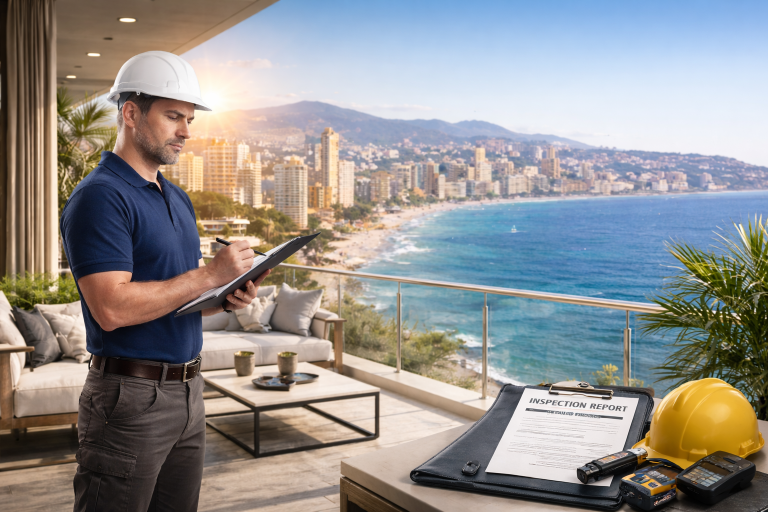
A professional property inspection for a remote buyer in Spain goes substantially further than the cursory walk-through a selling agent will offer. Before you sign a reservation agreement or hand over a deposit, you need a clear, unbiased picture of what you are actually buying.
Structural and physical condition
The inspector examines the foundations, load-bearing walls, roof structure, terraces, and any extensions or outbuildings. In coastal Spain, moisture ingress, rising damp, and salt damage are common — particularly in older properties that have been empty or poorly ventilated. Flat roofs on Spanish properties built before the 1990s deserve particular attention: they were frequently constructed without adequate waterproofing or falls, and small failures become expensive quickly.
Electrical, plumbing, and HVAC systems
Many resale properties in popular coastal areas carry installations that have not been updated for decades. The inspector will check whether the electrical installation meets current Spanish norms (the REBT), test water pressure at multiple outlets, inspect the boiler or solar hot water system, assess air conditioning units, and identify any deferred maintenance that could become urgent expenditure in the near term.
Legal and cadastral status
This is where remote buyers are most exposed to risk, and where professional representation delivers some of its most significant value. Your representative should verify that the property’s physical reality matches its legal description — that the built square metres recorded at the Land Registry (Registro de la Propiedad) match what actually exists, that any extensions have the relevant licences (or a prescription period that makes them regularisable), and that there are no outstanding debts, embargoes, or charges against the title.
In the Comunidad Valenciana, Murcia, and Andalucía — the regions that together account for the majority of British and Northern European purchases — there have historically been significant issues with properties built without or against planning permission. A professional check of the SUMA (or equivalent municipal tax records), the cadastre, and the nota simple from the Land Registry is non-negotiable.
Live video reporting
Modern remote inspections are conducted with the buyer present — via video call — so that you can ask questions in real time, request that the inspector open a specific cupboard, check a particular wall, or test the water at a given tap. A written report with photographs follows within 24 to 48 hours. Many representatives now use structured inspection software that produces a timestamped, geolocated record, making it easier for your lawyer to identify issues that need resolving before completion.
Renovation Oversight from Abroad: Managing Works Without Being There
The scenario plays out with predictable regularity. A buyer purchases a property at a price that reflects its need for renovation. A local friend or the estate agent recommends a builder. The buyer returns to London, Hamburg, or Stockholm. Weeks pass. Messages become less frequent. The quoted budget begins to expand. When the buyer eventually visits, the work is incomplete, inconsistent with what was agreed, or simply wrong.
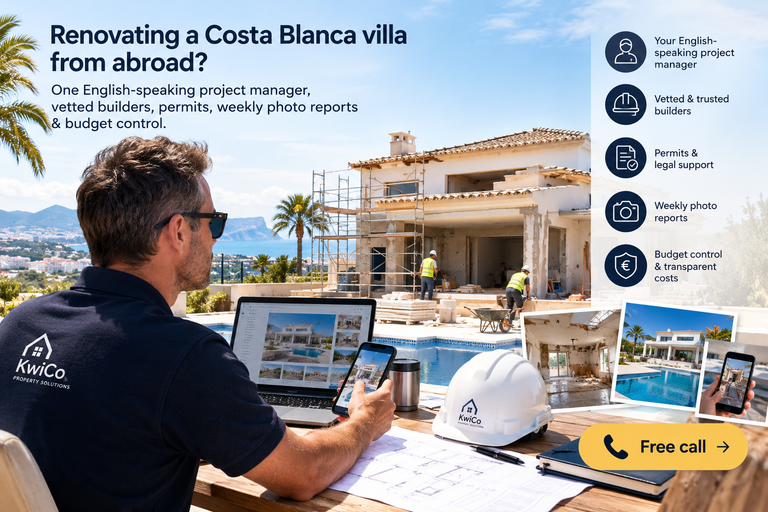
Remote renovation oversight — professional, paid, independent oversight — exists precisely to prevent this. A good representative in Spain manages renovation projects for foreign clients as a standalone service, and the value they deliver often far exceeds their fee.
What renovation oversight actually involves
Before works begin, your representative should be involved in obtaining and comparing multiple quotations from licensed contractors (autónomos or empresas with valid CIF and social security coverage). They should review the scope of works, identify ambiguities that could later be used to justify cost overruns, and help you establish a payment schedule tied to verified milestones rather than the contractor’s cash flow needs.
During works, your representative conducts regular site visits — weekly as a minimum, more frequently at critical phases — and provides you with photo and video updates after every visit. They check that materials specified in the quotation are the materials being installed, that work is proceeding in the correct sequence (waterproofing before tiling, structural work before cosmetics), and that any variations from the agreed scope are documented and approved before they are carried out.
Payment is the primary lever of control in any construction project. Your representative manages the release of staged payments against verified progress, preventing the contractor from drawing funds ahead of completed work. This single mechanism, properly applied, eliminates the majority of renovation disputes experienced by unrepresented foreign buyers.
Common renovation risks for unrepresented foreign buyers in Spain:
- Contractors substituting specified materials for cheaper alternatives without disclosure
- Undeclared subcontracting to unlicensed workers with no liability coverage
- Budget inflation through scope creep in the absence of a clear written agreement
- Work proceeding without required licences (licencia de obra menor or mayor)
- Final payment released before snagging list is resolved, eliminating leverage
- No habitation certificate (cédula de habitabilidad) obtained on completion
Home Watch Services: Protecting Your Spanish Property Year-Round
Spain’s property market is seasonal. The majority of foreign-owned properties in coastal areas are occupied for between four and twelve weeks per year — primarily summer, Christmas, and Easter. The remaining forty to forty-eight weeks, these properties sit empty.
An unoccupied property in Spain is not a static, neutral asset. It is subject to a continuous range of low-grade risks that, undetected, can become significant problems: a slow leak beneath the kitchen sink that ruins the cabinetry over three months; an ant infestation that establishes itself in autumn and has colonised the roof void by spring; a shutter blown open in a storm that allows water ingress into the bedroom; a burst pipe in a sudden cold snap in January that floods the ground floor before anyone is aware.
A professional home watch service addresses this through regular scheduled visits — typically fortnightly, though monthly is adequate for lower-risk properties — combined with a clear protocol for emergency response. At each visit, your representative checks the exterior and interior of the property, tests taps and drainage, checks the electrical panel, inspects the pool (if applicable), airs the property, and provides a written log with photographs that is transmitted to you within 24 hours of the visit.
What home watch covers in practice
Beyond the standard inspection visit, a comprehensive home watch service acts as your permanent local contact for everything the property requires. This includes coordinating annual maintenance contracts (boiler service, air conditioning cleaning, pool care), managing utility bills and ensuring supplies remain connected, meeting contractors who need access, accepting deliveries of furniture or appliances, and being the first point of call for the community administrator (administrador de fincas) or local authorities.
For buyers who also let their property as a holiday rental, home watch extends into arrival and departure checks, key holding, linen coordination, and the resolution of any guest issues that arise during a stay — services that would otherwise require either the owner’s physical presence or an expensive holiday lettings management company.
Upgrade Coordination: Increasing Value Before You Arrive
An increasing number of buyers purchasing in Spain remotely are not buying finished, move-in-ready properties. They are deliberately acquiring properties that need work — at a price that reflects that condition — with the intention of improving them into either a personal home of high quality or an investment asset with strong rental appeal.
Upgrade coordination is the service that bridges the gap between a property’s condition at purchase and the finished result the buyer has in mind. It is distinct from renovation oversight in that it involves the representative not merely supervising an agreed scope of works but actively contributing to the design, specification, and sourcing decisions that define what the upgrade will achieve.
Interior design and specification
Your representative should be able to guide you through material selections — kitchen fronts, floor tiles, bathroom sanitaryware, external paint colours, pool coping stones — within your budget and aesthetic brief, sourcing from local suppliers in Murcia, Alicante, or Málaga where value and quality are typically superior to imported alternatives. They attend showrooms on your behalf, obtain samples, and present structured options with pricing for you to decide remotely.
Value-adding improvements
For investment buyers, the representative can advise on which improvements generate the strongest return in the local rental or resale market. In coastal Murcia and the Costa Blanca, for example, a private pool on a property without one typically increases both rental yield and resale value significantly — but only if the garden size and orientation support it and the licence can be obtained. A new kitchen in a property positioned at the lower end of the local rental market will not recover its cost; the same investment in a property targeting the premium market will. A local representative with active knowledge of what buyers and renters are paying for in your specific area is better placed to make this calculation than any amount of online research conducted from abroad.
The Legal Process for Remote Buyers in Spain
Buying property in Spain as a non-resident is a well-established legal process. It is not complicated, but it does require preparation and the engagement of a qualified independent lawyer (abogado) — not a gestor, not a notary acting for both parties, and not the estate agent’s in-house legal service.
NIE number
Every foreign buyer needs a Número de Identificación de Extranjero (NIE) before a Spanish property purchase can complete. The NIE is your fiscal identity number in Spain and is required for the deed of sale, tax payments, and utility contracts. It can be obtained at a Spanish consulate in your home country — a process that typically takes two to four weeks — or in Spain directly. For remote buyers, the NIE application is commonly handled by your lawyer via Power of Attorney.
Power of Attorney
A Poder Notarial — Power of Attorney — allows your lawyer or a trusted representative to sign documents and complete the purchase on your behalf in Spain. The Power of Attorney must be executed before a notary in your home country and apostilled (authenticated under the Hague Convention) before it is valid in Spain. Your Spanish lawyer will provide the precise wording required. This is the mechanism that makes fully remote completion possible.
The purchase process
The typical purchase sequence begins with a reservation agreement and deposit (usually €3,000–€6,000) to take the property off the market while due diligence is conducted. This is followed by a private purchase contract (contrato de arras) — most commonly arras penitenciales under Article 1454 of the Spanish Civil Code — which fixes the price, completion date, and conditions, with a deposit of typically 10% of the purchase price. Completion takes place before a Spanish notary with the signing of the escritura de compraventa, payment of the balance, and registration of the new ownership at the Land Registry.
Buying costs to budget for (resale property):
- Impuesto de Transmisiones Patrimoniales (ITP) — Transfer tax of 8–10% of the purchase price depending on the autonomous community
- Notary fees — Regulated scale, typically €600–€1,200
- Land Registry fees — Regulated scale, typically €400–€800
- Lawyer’s fees — Typically 1% of purchase price plus IVA, minimum €1,500
- Buyer’s representative / inspection fees — Variable; budget €500–€2,500 depending on scope
- Total acquisition costs — Allow 10–13% of purchase price above the agreed price
Step-by-Step: How to Buy Property in Spain Remotely
Step 1 — Define your brief Location, budget, property type, intended use (personal, rental, investment). Share it with your representative before anything else.
Step 2 — Appoint your lawyer and representative Independent lawyer for legal due diligence. Buyer’s representative for physical inspection and on-site coordination. These are two separate roles and should be two separate people.
Step 3 — Property search Your representative shortlists, visits, and reports. You review and shortlist further via video call walkthroughs. No flights required at this stage.
Step 4 — Inspection and due diligence Full physical inspection plus legal checks on title, planning status, debts, and charges. Issues identified and resolved before any commitment is made.
Step 5 — Negotiate and reserve Your representative or lawyer negotiates on your behalf. Reservation agreement secures the property while due diligence completes.
Step 6 — Arras contract 10% deposit. Fixes price and completion date. Conditions precedent (NIE, mortgage if applicable) agreed in writing.
Step 7 — Completion (escritura) Signed at notary by your lawyer under Power of Attorney. Balance transferred. Keys collected on your behalf.
Step 8 — Post-completion Registration, utility transfers, community fees set up. Home watch and/or renovation oversight commences.
Costs and Realistic Timelines
Remote buyers sometimes assume the process will be slower than a conventional purchase. In practice, the opposite is often true: when a professional representative is coordinating the inspection, the lawyer is receiving a clear brief, and the buyer is available for video calls rather than waiting for viewing trips, the timeline from offer to completion is often shorter than for buyers who insist on travelling to Spain for each stage.
A straightforward resale purchase with no mortgage, clear title, and a motivated seller typically completes in six to ten weeks from reservation. Purchases involving a mortgage, properties with historical planning issues requiring regularisation, or sellers with complex estate situations take longer — three to six months is realistic and should be budgeted for.
Renovation timelines in Spain are notoriously difficult to predict, and any buyer or representative who quotes a firm completion date for a significant renovation before works have begun is being optimistic. A cosmetic refresh (kitchen, bathrooms, painting, flooring) in a standard two-bedroom apartment typically takes eight to twelve weeks with a competent team. Structural work, pool installation, or full property rehabilitation should be budgeted at four to twelve months. Your representative’s role is to compress these timelines where possible and to keep you informed when delays occur.
How to Buy Property in Spain Remotely: Frequently Asked Questions
Can I get a mortgage in Spain as a non-resident buying remotely?
Yes. Spanish banks offer mortgages to non-resident buyers, typically up to 60–70% of the purchase price or valuation (whichever is lower). The process can be initiated remotely through a Spanish mortgage broker who has relationships with multiple lenders. Pre-approval before making an offer strengthens your position considerably.
Do I need to visit Spain at all during the purchase process?
With a Power of Attorney in place, there is no legal requirement to be physically present at any stage of a Spanish property purchase. Many buyers choose to visit at least once — often after completion, to see their property for the first time — but it is entirely possible to complete without setting foot in Spain.
What is the difference between a buyer’s representative and an estate agent?
An estate agent in Spain is typically paid by the seller and has a financial incentive to complete the transaction at the highest possible price. A buyer’s representative is paid by the buyer and has no interest in which property you buy or at what price — only in ensuring that whatever you buy is what it appears to be and that your interests are protected throughout.
How does home watch work in practice when there is an emergency?
Your representative holds a set of keys and has an agreed emergency protocol. For urgent issues — active water leak, break-in, storm damage — they attend the property, assess the situation, and take immediate action (isolating water supply, making the property secure) before contacting you with a full report. For significant works required urgently, they obtain at least two quotations and do not authorise expenditure above an agreed threshold without your approval.
Is buying property in Spain remotely safe?
The risks of remote purchase are not different from the risks of any property purchase in Spain — they are simply harder to manage without local presence. With a qualified independent lawyer conducting legal due diligence and a professional buyer’s representative conducting physical due diligence, the risks are well-controlled. The buyers who encounter serious problems are those who rely on the selling agent’s assurances and skip independent professional representation to save costs.
How do I find a trustworthy buyer’s representative in Spain?
Ask for references from previous clients — specifically non-resident foreign buyers — and speak to those clients directly. Confirm that the representative carries professional indemnity insurance and is not affiliated with any estate agency or developer. A representative who also operates as a selling agent has a conflict of interest that undermines the entire purpose of independent representation.
What areas of Spain are most popular for remote buyers from the UK, Germany, and Scandinavia?
The Costa Blanca (Alicante province), the Region of Murcia (Mar Menor, Mazarrón, Águilas), the Costa del Sol (Málaga province), and the Balearic Islands account for the majority of purchases by Northern European remote buyers. Each market has distinct characteristics in terms of property type, price point, rental demand, and planning complexity.
 79
79
 35
35
 20
20