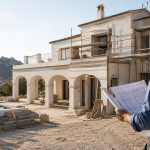
How to renovate a villa in Spain if you don’t live there? The safest way is to appoint a reliable local renovation coordinator who can inspect the property, organise the right professionals, compare quotations, monitor the work and report back to you remotely. You don’t need to live in Spain to renovate your villa successfully—but you do need someone on the ground who represents your interests.

For thousands of overseas property owners, this is the real challenge. You may own a villa on the Costa Blanca, but live in the UK, Germany, France, the Netherlands, Scandinavia or elsewhere. You can’t visit the property every week, meet every contractor or discover problems before they become expensive.
That is why remote villa renovation in Spain is primarily a coordination and control problem—not a builder-finding problem.
Start With the Property, Not the Contractor
Before asking contractors for prices, establish what you actually have.
A villa that looks fine in photographs may have hidden problems with waterproofing, drainage, plumbing, electrics, the pool, roof, garden or previous alterations. Older properties can also contain extensions, enclosed terraces, outbuildings or other modifications whose planning status should be checked before you incorporate them into a new renovation.
The first stage should therefore be a property and renovation assessment.
The objective is simple: understand the condition of the property, identify the work that really needs doing and define the project before contractors start adding their own assumptions.
Check What You Are Legally Allowed to Change
Spanish renovation rules depend on the property, municipality and type of work.
Not every renovation requires the same procedure. Depending on the project, you may be dealing with a licencia de obra, declaración responsable, technical documentation or a qualified professional such as an architect or technical architect.
For example, Alicante’s municipal procedures distinguish between different types of works. Certain non-structural reforms can fall under minor works or responsible-declaration procedures, while more substantial interventions can require a major works licence and technical documentation.
This is particularly important if you want to change the structure, extend the building, modify external areas, alter a pool, create a new enclosed space or make substantial changes to the property.
Never assume that a contractor’s statement that “no permit is needed” is enough.
For a remote owner, confirming the correct procedure before construction begins can prevent a very expensive mistake later.
Define the Renovation Before You Compare Prices
Once the property and legal position are understood, create a clear scope of work.
Instead of telling three builders:
“I want to renovate my villa.”
define exactly what you want to achieve.
For example, a Costa Blanca villa renovation might combine an internal refurbishment with a pool-deck renovation, garden clearance, drainage improvements, outdoor lighting, pergola, solar energy and smart-home upgrades.
Once the scope is defined, contractors can quote against the same project.
That makes quotations much easier to compare—and exposes the classic problem of a cheap quote that simply excludes half the work.
Who Should Manage a Villa Renovation When You Live Abroad?
This is where the remote renovation model becomes different from a normal renovation.
You need someone who can act as your local eyes and ears.
That person can coordinate contractors, arrange access, attend site visits, photograph progress, identify problems, compare work against the agreed scope and keep you informed.
The builder should build.
The architect or technical professional should perform the professional functions required for the project.
And someone should make sure your interests as the owner are being represented.
Those roles don’t always have to be performed by the same company or person.
How Do You Control a Renovation Remotely?
The answer is documentation.
You should be able to see what has happened at your villa without getting on a plane.
A good remote renovation system gives you regular progress photographs, short videos, budget updates and clear explanations of anything that has changed.
More importantly, additional work should be approved before it becomes additional expenditure.
If a contractor discovers a damaged pipe behind a wall, for example, you should receive the evidence, proposed solution and additional cost before the work proceeds where circumstances allow.
This turns WhatsApp from a chaotic stream of messages into an actual project-control system.
Don’t Pay for “Progress” You Can’t Verify
Remote villa renovations should be structured around agreed milestones rather than unlimited advances.
The principle is straightforward:
work is completed → progress is documented → work is checked → payment is released.
You should also photograph important hidden work before it disappears behind walls, floors or paving.
Waterproofing, drainage, pipework, electrical installations and other concealed elements are much easier to verify before they are covered.
That photographic record can become extremely useful years later.
What About Unexpected Renovation Costs?
Every renovation has unknowns, particularly in older Spanish properties.
The solution isn’t pretending that surprises won’t happen.
The solution is having a defined change-control process.
If the project changes, you should know:
what changed, why it changed, what it costs and whether it affects the schedule.
That gives you control over the renovation budget without pretending that every wall in a 30-year-old villa will behave politely.
Renovating a Villa in Costa Blanca Is Also an Opportunity
If you are already investing in a major renovation, it can make sense to look beyond aesthetics.
A remote property may benefit from improvements such as better drainage, waterproofing, solar energy, battery storage, EV charging, smart security, leak detection, automated irrigation and remote monitoring.
The question becomes:
How can this villa be easier, safer and cheaper to own when I’m not there?
That is a much more valuable question than simply asking which tiles look best.
What Happens When the Renovation Is Finished?
Completion should not mean:
“The builders have left.”
The final stage should include a proper inspection, snagging, correction of defects and collection of the relevant documentation, warranties, certificates and equipment information.
This matters particularly when the property is going to remain empty for periods of the year.
You want to finish with a property that is documented and operational, not simply a house that looks finished in photographs.
Can You Renovate a Villa in Spain Completely Remotely?
Yes.
But completely remote does not mean completely hands-off.
The owner can make decisions from abroad while local professionals handle the physical reality in Spain.
The winning formula is:
Assess → Plan → Check → Quote → Coordinate → Verify → Complete.
That is the difference between simply hiring a builder and actually managing a remote villa renovation.
Renovating a Villa on the Costa Blanca While Living Abroad?
If your property is in Torrevieja, Orihuela Costa, Guardamar, Ciudad Quesada, La Marina, Santa Pola, Alicante or elsewhere on the Costa Blanca, KwiCo can act as the local coordination layer between you, technical professionals and contractors.
From the initial property assessment and renovation scope to contractor quotations, outdoor works, project coordination, progress reporting, snagging and smart-property upgrades, the goal is simple:
You don’t have to live in Spain to stay in control of your Spanish property.
Your villa stays here. Your control doesn’t have to.
 79
79
 35
35
 20
20