
Water has a special talent for causing chaos quietly. A small, unnoticed leak can work 24/7 behind walls, under floors, or beneath appliances—until one day it announces itself with warped wood, mold, or an eye-watering repair bill. Smart water leak detector exists precisely to stop that story from reaching its expensive ending.
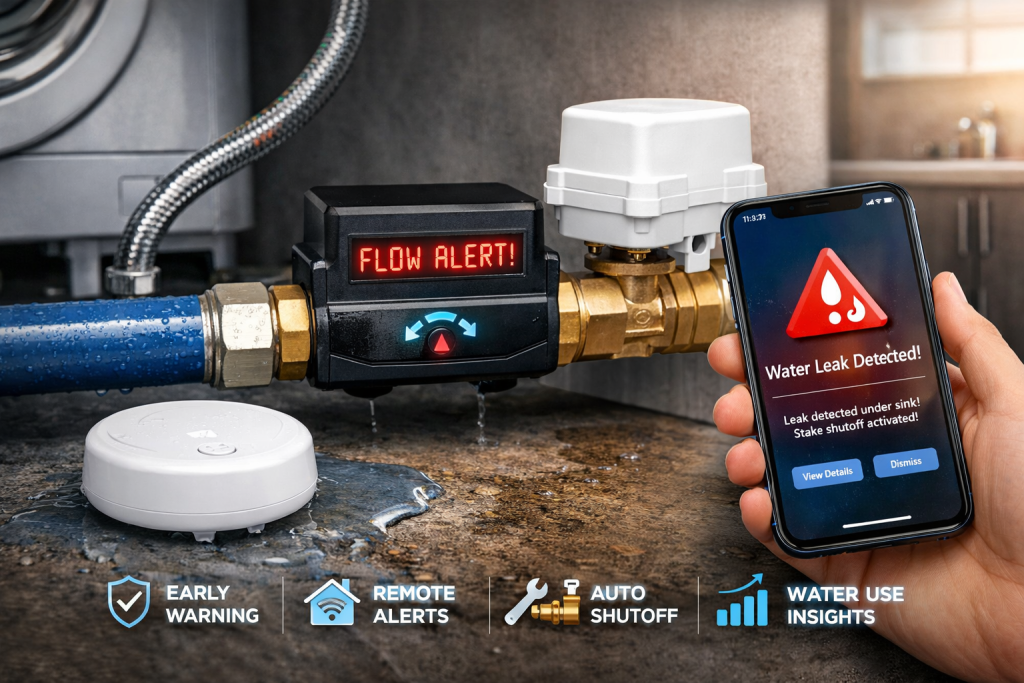
This guide explains what they are, how they work, and why they’re quickly becoming a standard feature in well-designed, future-ready homes.
What Is a Smart Water Leak Detector?
A smart water leak detector is a connected device that identifies the presence of water where it shouldn’t be—or detects abnormal water usage—and alerts you instantly. Instead of relying on luck or periodic visual checks, these systems keep watch around the clock.
Compared to traditional alarms that only beep locally, smart detectors:
- Send alerts directly to your phone
- Work even when you’re away from home
- Integrate with other smart home systems
- Can trigger automatic actions, such as shutting off the water supply
In short, they don’t just warn you—they give you time to act.
How Smart Water Leak Detector Actually Works
Most modern systems combine several sensing methods for accuracy and reliability:
Moisture Detection
Small sensors placed on floors or near pipes detect even minimal amounts of water. The moment moisture bridges the sensor contacts, an alert is triggered.
These sensors provide early leak detection in kitchens, bathrooms, basements, and utility rooms—long before visible damage appears. By instantly notifying homeowners via smart home systems or mobile alerts, moisture detection helps prevent costly water damage, mold growth, and structural repairs in both residential and commercial properties.
Water Flow Monitoring
Installed on the main water line, these devices measure how water moves through your home. Continuous flow at unusual times or sudden spikes can indicate a hidden leak.
This real-time water usage analysis allows the system to distinguish between normal household consumption and abnormal patterns linked to leaks. When irregular flow is detected, smart water monitors can send instant alerts or automatically shut off the water supply to prevent flooding and reduce water waste.
Temperature and Humidity Monitoring
Rapid changes in humidity or drops in temperature can signal condensation issues or frozen-pipe risks before damage occurs.
By tracking environmental conditions around plumbing and walls, these sensors help identify high-risk areas for leaks and pipe failures. Early temperature and humidity alerts support preventive maintenance, reducing the chances of burst pipes, mold growth, and expensive emergency repairs.
Learning Your Home’s Habits
More advanced systems observe daily water usage and learn what’s normal for your household. When something deviates from that pattern, you’re notified—often before visible damage starts.
This adaptive monitoring improves leak detection accuracy by reducing false alarms while catching unusual water activity faster. Over time, AI-driven analysis creates a personalized water-use profile that helps protect your home from hidden leaks, water waste, and unexpected repair costs.
Where Smart Water Leak Detector Makes the Biggest Difference
Placement matters more than the number of devices. The most common problem areas include:
- Under kitchen and bathroom sinks
- Behind washing machines and dishwashers
- Near water heaters and boilers
- In basements and utility rooms
- Around sump pumps
- At the main water inlet
Many homeowners combine point sensors with a single flow monitor for whole-house protection.
Smart Water Leak Detection Through the Lens of Professional Property Oversight
In our home inspection and renovation supervision work, water damage remains one of the most underestimated risks in residential property. What looks like a minor drip today can quietly evolve into structural decay, insulation failure, mold development, and costly restoration tomorrow. That’s why more homeowners are integrating smart water leak detection as part of a broader property protection strategy — not as a gadget, but as a risk management tool.
Early Intervention Protects Structure — Not Just Surfaces
During inspections, we often see damage that began with something as simple as a loose fitting or slow pipe seepage. When detected early, the fix is minor. When ignored, it can require replacing flooring systems, drywall, cabinetry, and even structural timber elements. Smart detection shortens response time dramatically — and in property supervision, time is cost.
Remote Awareness for Owners and Investors
For second-home owners, rental investors, or clients overseeing renovations from abroad, remote monitoring provides continuous oversight. Instead of relying solely on periodic site visits, you receive immediate alerts. In supervised renovation projects, this adds an extra layer of security when new plumbing installations are pressure-tested and commissioned.
Data Visibility Reduces Hidden Risks
Flow monitoring systems reveal abnormal consumption patterns that traditional inspections cannot capture between visits. Slow, continuous leaks often escape attention until utility bills spike or materials deteriorate. Usage history becomes a diagnostic tool — especially valuable in adapted homes with upgraded plumbing layouts.
Property Value and Buyer Expectations
Modern buyers increasingly expect integrated safety infrastructure. During pre-sale inspections, homes equipped with leak detection and automatic shutoff systems demonstrate proactive maintenance culture. In competitive markets, that signal matters. It suggests the property has been managed, not merely occupied.
What the Investment Covers in a Supervised Property Context
Costs vary depending on the level of integration:
- Basic leak sensors – ideal for high-risk zones identified during inspection (under sinks, near boilers, laundry areas).
- Multi-sensor systems – suitable for larger properties or recently renovated homes with distributed plumbing.
- Flow monitoring units – recommended when assessing older properties or buildings with complex pipe networks.
- Automatic shutoff valves – critical for vacant homes, holiday properties, and high-value interiors.
- Professional installation and calibration – particularly important when integrated into main supply lines during renovation works.
From a property oversight perspective, even one prevented incident typically offsets the entire system cost. Water remediation rarely stops at the visible surface — it spreads into subfloors, insulation, and structural cavities.
The Next Phase: From Reactive to Predictive Protection
The technology is evolving toward predictive maintenance:
- Seasonal consumption analysis to flag anomalies
- Freeze-risk alerts aligned with weather data
- Insurance-ready incident reports
- Maintenance insights for aging plumbing systems
In renovation planning and home adaptation projects, this aligns perfectly with forward-thinking property management: buildings that don’t just respond to failures — they anticipate them.
Selecting the Right System During Inspection or Renovation
When advising homeowners, we evaluate:
- Spot detection vs. full-line flow monitoring
- Need for automatic shutoff in unoccupied periods
- Battery backup reliability during outages
- Depth of reporting required for long-term property supervision
The optimal solution isn’t the one with the longest feature list. It’s the one that integrates logically into the property’s technical profile, occupancy pattern, and renovation roadmap.
Because in property management, prevention isn’t an upgrade — it’s leverage.
Smart Water Leak Detector: Common Questions Answered
Are smart water leak detectors really necessary?
For homes with modern appliances, hidden plumbing, or frequent absences, they’re one of the most effective preventive tools available.
Do they work if the internet goes down?
Most continue local detection and alarms, but remote notifications typically require connectivity.
How many sensors does a home need?
Most households are well covered with sensors in key risk zones plus one central monitoring device.
Final Perspective from a Property Oversight Standpoint
In professional home inspection and renovation supervision, water damage is rarely dramatic at the beginning. It doesn’t break in with noise — it advances quietly behind walls, beneath flooring systems, inside insulation cavities. By the time visible signs appear, structural materials may already be compromised.
Smart water leak detection changes that equation entirely. It eliminates silence, shortens reaction time, and introduces measurable control into one of the most common sources of property deterioration. For supervised renovation projects and adapted homes, this means reduced latent risk and greater long-term asset stability.
Looking ahead, responsible property management will no longer rely on hope that plumbing “behaves.” Integrated monitoring and automatic response systems will become standard infrastructure — just like proper insulation or electrical protection.
In future-ready homes, water is no longer assumed to be harmless. It is monitored, managed, and, when necessary, stopped instantly.
 79
79
 35
35 20
20







3 Comments