Smart home security Costa Blanca isn’t about paranoia. Instead, it’s about not being the easiest house on the internet to mess with. And yes — many homes still are.
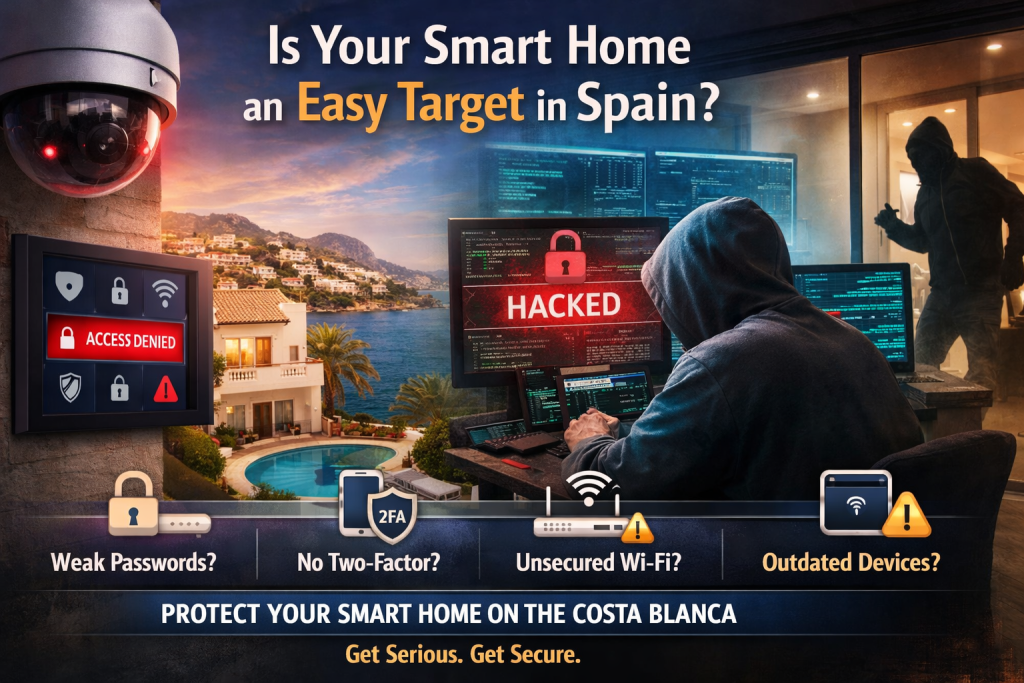
Smart homes are everywhere on the Costa Blanca. From Alicante apartments to villas near the sea, homes are getting smarter, faster, and more connected. However, here’s the twist: the smarter the home, the more attractive it becomes to digital opportunists.
In fact, if your smart home was installed quickly, cheaply, or “it worked out of the box,” keep reading. This article explains how professionals in Spain secure their smart homes — and why it matters more here than you think.
Why Smart Home Security in Spain Is a Real Issue
Spain has a few unique realities that affect smart home security:
Many homes are second residences or holiday rentals
Wi-Fi networks change often
Guests, cleaners, and property managers need access
Coastal areas attract both tourists and… attention
As a result, poorly secured smart homes become low-hanging fruit. Hackers don’t target people — they target mistakes.
The good news? Most risks are easy to eliminate.
1. Smart Home Security Costa Blanca Starts With Strong Passwords
First and foremost, passwords still matter. A lot.
Many security breaches happen because:
default passwords were never changed
the same password is reused everywhere
an old email password was leaked years ago
As a result, cameras, alarms, or smart locks become accessible in minutes.
Best practice in Spain: Use unique passwords for every device and platform. In professionally installed systems, credentials are generated securely and documented properly — not scribbled on paper or forgotten.
Although it adds one extra step, it also adds one massive barrier for intruders. Even if a password leaks, access still isn’t granted.
Most smart home platforms used in Spain already support it. Therefore, turning it off simply removes a layer of protection you already paid for.
In short: inconvenience for you, nightmare for hackers.
3. Secure Wi-Fi = Secure Smart Home
Your Wi-Fi network is the digital front door of your home. Unfortunately, many homes on the Costa Blanca still rely on:
old routers
default settings
shared passwords
This is risky.
Smart home security in Spain works best when:
WPA2 or WPA3 encryption is active
guest networks are separated
smart devices run on their own network
In fact, professionals often segment networks so that even if one device fails, the rest of the home stays protected.
4. Firmware Updates: The Silent Protector
Smart devices are constantly updated for a reason. Manufacturers regularly patch vulnerabilities that hackers already know about.
However, many users ignore updates because “everything works fine.”
Unfortunately, hackers love that attitude.
So, enable automatic updates whenever possible. That way, your smart home security on the Costa Blanca stays current — even when you’re not around.
5. Smart Home Security Costa Blanca: Disable What You Don’t Use (Especially Cameras)
More features don’t always mean more security.
If you don’t need:
remote access
constant cloud connection
third-party integrations
Then disable them.
Each unnecessary feature increases exposure. In contrast, professionally configured systems focus on functionality first, exposure last — which is especially important for homes with cameras or microphones.
6. Choose the Right Brand — and the Right Installation
Finally, brand choice matters. But installation matters more.
Even well-known smart home brands have suffered data leaks. Therefore, never rely on reputation alone.
Before installing:
check how data is stored
confirm EU privacy compliance
look for local experience in Spain
On the Costa Blanca, more homeowners now prefer tailored smart home security solutions rather than DIY kits that age badly.
Why Smart Home Security Costa Blanca Is Moving Toward Professional Solutions
Because many homes here are:
remote
rented
seasonally occupied
In other words, security systems must be reliable, simple, and future-proof. That’s why professionally planned smart and security installations are becoming the standard — not the luxury.
A secure smart home should work quietly in the background, not demand attention.

 79
79
 35
35
 20
20











One Comment